



How to Modernize Historically Inspired Wood Doors
A home can honor its heritage while incorporating modern innovations
Tudor homes are known for their medieval charm, masonry, and steeply pitched roofs. Modern homes favor clean lines, simple forms, and restrained details. Both styles can embrace new technology and improvements while preserving their architectural character.
When it’s time to replace your front or garage door, CAMBEK can help. We craft custom doors that harmonize with the surrounding architecture and complement your lifestyle.
The Enduring Appeal of Tudor Revival
Tudor Revival homes emerged in the late 19th and early 20th centuries as a modern interpretation of medieval English architecture from the Tudor period (1485-1603). Originally built for the upper class, they became a favored choice for high-end residential design in affluent American neighborhoods. According to the Pennsylvania Historical and Museum Commission, Tudor Revival ranked second only to Colonial Revival in residential popularity during the 1920s and 1930s.
The features often feel as if they were pulled from a fairy tale.
- Steeply pitched roofs with multiple gables
- Half-timbering filled with stucco or masonry
- Tall leaded-glass casement windows, often with diamond-shaped window panes
- Prominent chimneys
- Arched doorways with heavy wooden doors and iron hardware that evoke the atmosphere of medieval castles and manor houses
- Brick and stone walls
The picturesque aesthetic of Tudor homes often calls for custom wood entry and garage doors. Local home improvement stores rarely carry these architectural classics.
Designing a Garage Door for a Tudor Home
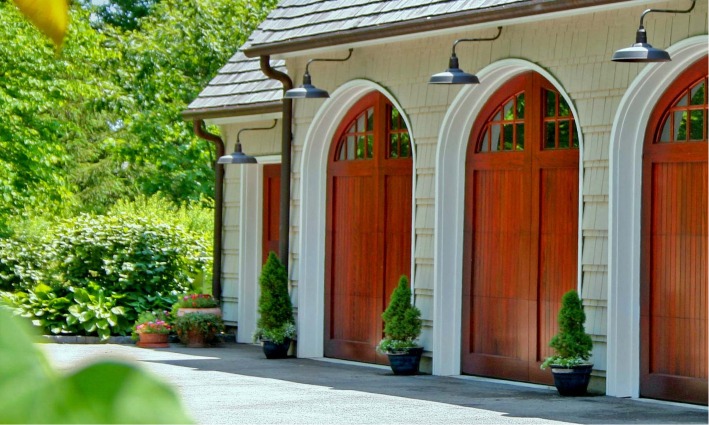
A garage door can take up a significant portion of a home’s front elevation, making it a major part of its curb appeal. CAMBEK designed overhead doors for a Tudor home with that in mind, echoing the timber-framing pattern without competing with the mosaic daub and wattle.
We adjusted the top section’s height so the four curved diamond details align symmetrically across each opening. Traditional door hardware, including wrought-iron strap hinges, large pull handles, and decorative studs in an antique finish, reinforced the carriage-door character. Proportions, pattern, and hardware tied the garage doors to the home’s architecture.
Historic Design, Modern Function
You can combine historical accuracy with modern convenience in any door design. Carriage doors once served horses and carriages, while today’s versions welcome cars and incorporate modern technology and performance. A Tudor door can retain its iron hinge straps and leaded glass while adding smart features such as remote access, electric openers, and discreet, integrated security.
As ArchDaily notes, a new generation of architects is redefining craftsmanship by pairing traditional artisan knowledge with modern technology. The design remains rooted in tradition, while the engineering propels it forward.
Where Minimalism Comes From
Minimalism in architecture draws on Japanese Zen philosophy, Cubism, and the Bauhaus movement of the 1920s. Ludwig Mies van der Rohe gave it its clearest voice with his ethos, “less is more.” In the Midwest, Frank Lloyd Wright’s Prairie and Usonian homes helped define a distinctly American modernism that influenced mid-century design. Without ornament, space becomes an active focal point, drawing the eye to clean lines and fine craftsmanship.
A custom door built on this logic embodies the same philosophy. Concealed hinges disappear into the frame, and smart hardware is integrated into the door. The technology works behind the scenes, keeping the focus on the wood and craftsmanship.
Architecture That Combines Aesthetics
The Metropolitan Museum of Art is a good example of how different architectural styles can coexist. Built and expanded over more than a century, New York’s iconic museum combines Victorian Gothic, Beaux-Arts Classicism, modern geometric forms, and contemporary design. Its architecture reflects different eras without requiring every addition to match the others.
That same principle can apply on a smaller scale. When several influences converge, thoughtful proportions and carefully selected materials can create a door that beautifully unites them.
Solid Wood as the Foundation
Technology may determine how a door functions, but the material governs how it looks and feels. Real wood offers variation that manufactured materials can’t replicate. Grain varies from board to board, and color deepens with age. On a large garage door, those natural variations keep the surface from feeling flat or static.
Every CAMBEK door begins with two wood species, each selected for its strengths. Clear Douglas fir provides dimensional stability for the frame, while Clear Western Red Cedar forms the surface millwork, contributing both beauty and resistance to the elements.
Craft That Respects the Style
Minimalist and historically inspired doors may look worlds apart, yet both begin with careful attention to the surrounding architecture and natural materials. Proportion, joinery, and detail guide every custom design.
If your home calls for doors that honor its history and let the wood take center stage, let’s begin the design conversation.
Get in Touch with Cambek
Share On


